Team
Anita Daniel
Sofia Walton
Erzhen Wei
Timeline
20 weeks
Role
Product Designer
Tools
FigJam
Figma Design
Google Forms
Overview
Park smarter. Stress less.
I served as a product designer for an app to streamline the process of finding parking in Seattle’s University District. For this project, I conducted competitor analysis and user research and translated insights into a tangible solution.
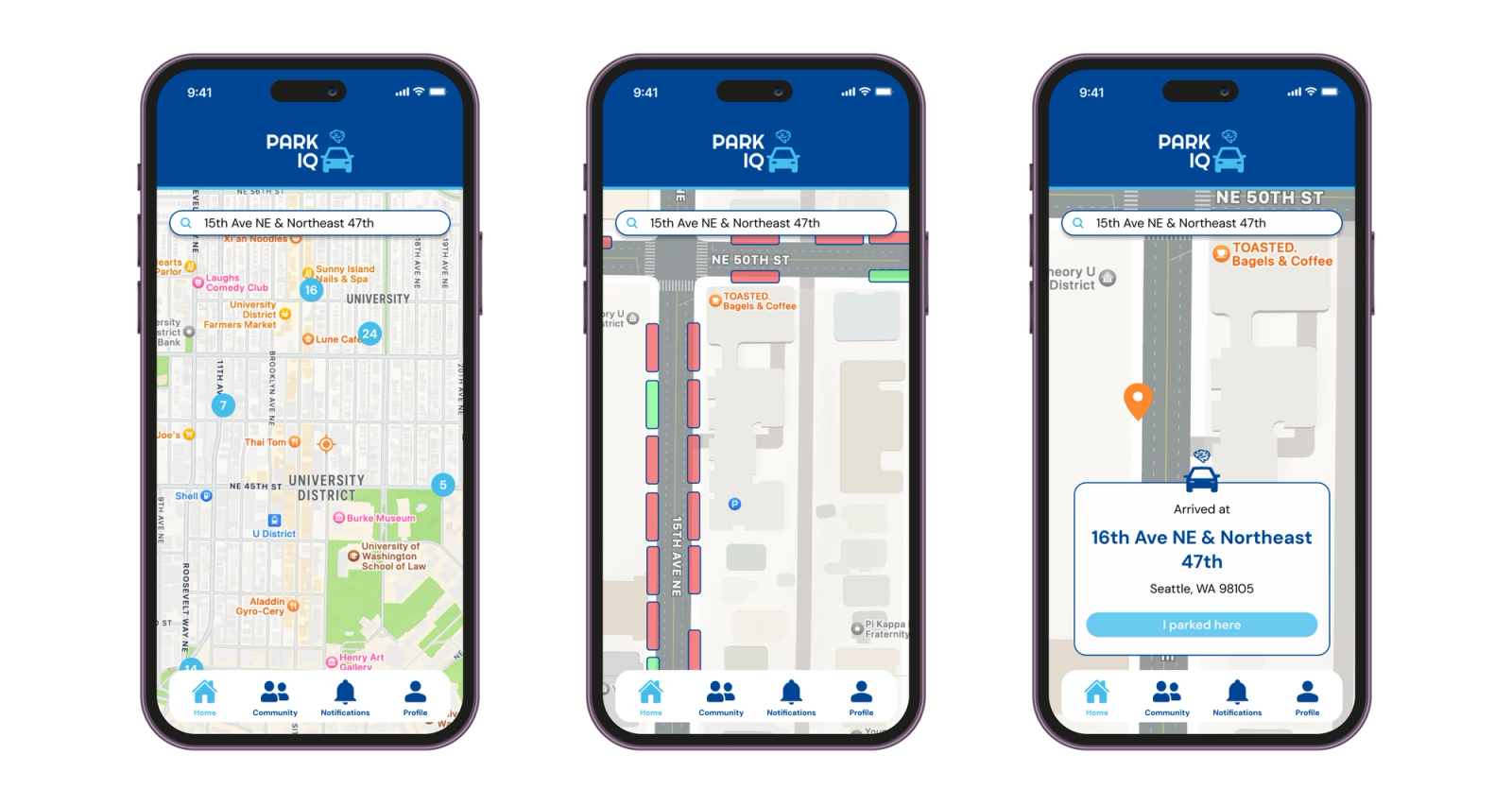
ParkIQ is an informational mobile app that shows users parking updates and availability based on data from in-ground sensors and community-crowdsourced data.
Context
Parking in UDistrict is really, really hard
If you’ve ever been in Seattle’s University District, you would know how difficult it is to find parking there. As some say on Reddit, it “might be the worst place in the whole city for parking.”
Some contributors to this issue include transit-oriented roads, lack of parking garages, confusing signage, and exorbitant and varying parking fees.
Solution
Meet ParkIQ
ParkIQ is a mobile application that allowing users to leave feedback and updates on parking through a community forum, as well as reference real-time parking data from in-ground sensors, making parking easy and efficient.
Users can choose a spot and learn important information about its hourly rate, time limits, safety, etc. by clicking on clusters or zooming into the map. Once the user has chosen a spot, they can navigate there using their preferred navigation platform.
If the spot becomes unavailable while the user is navigating to it, the app will send a notification and suggest nearby parking spots.
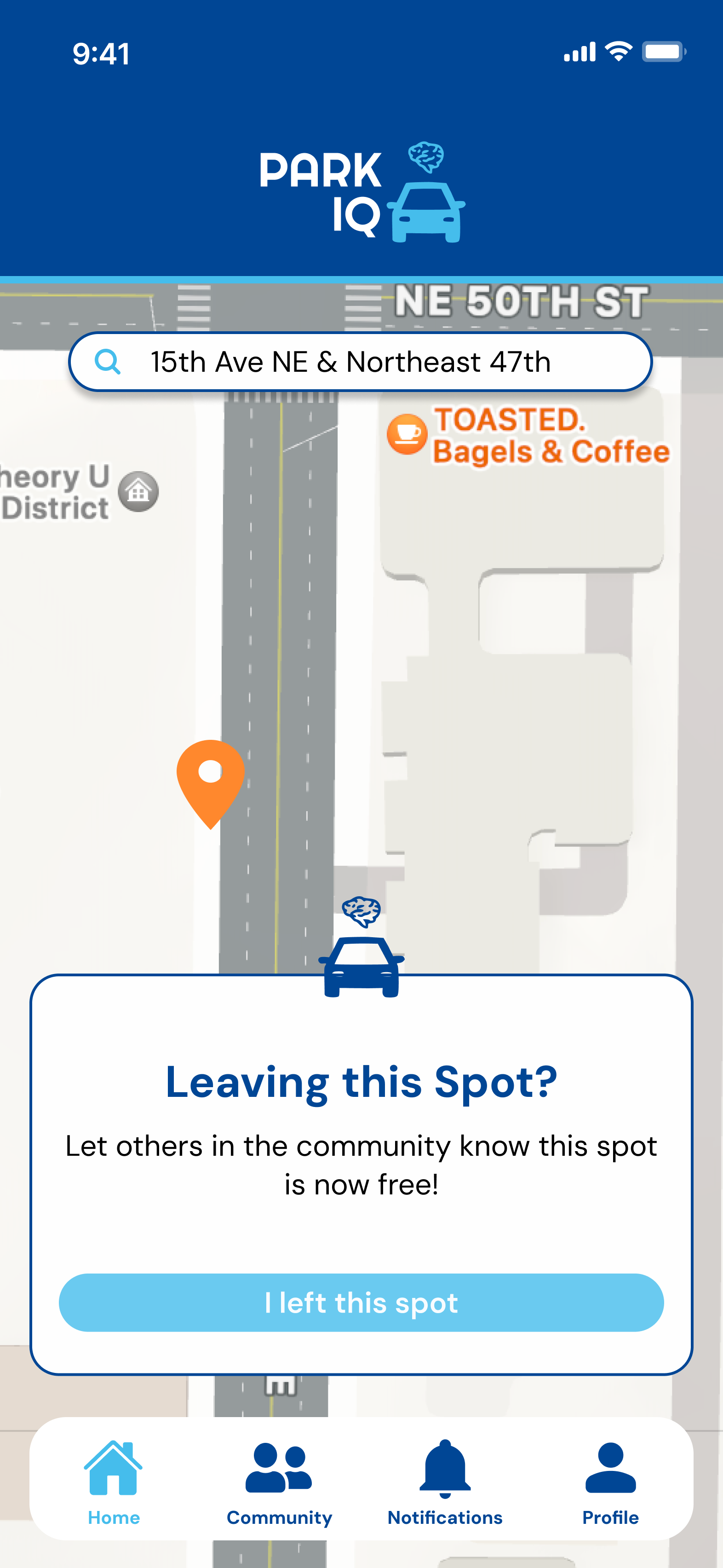
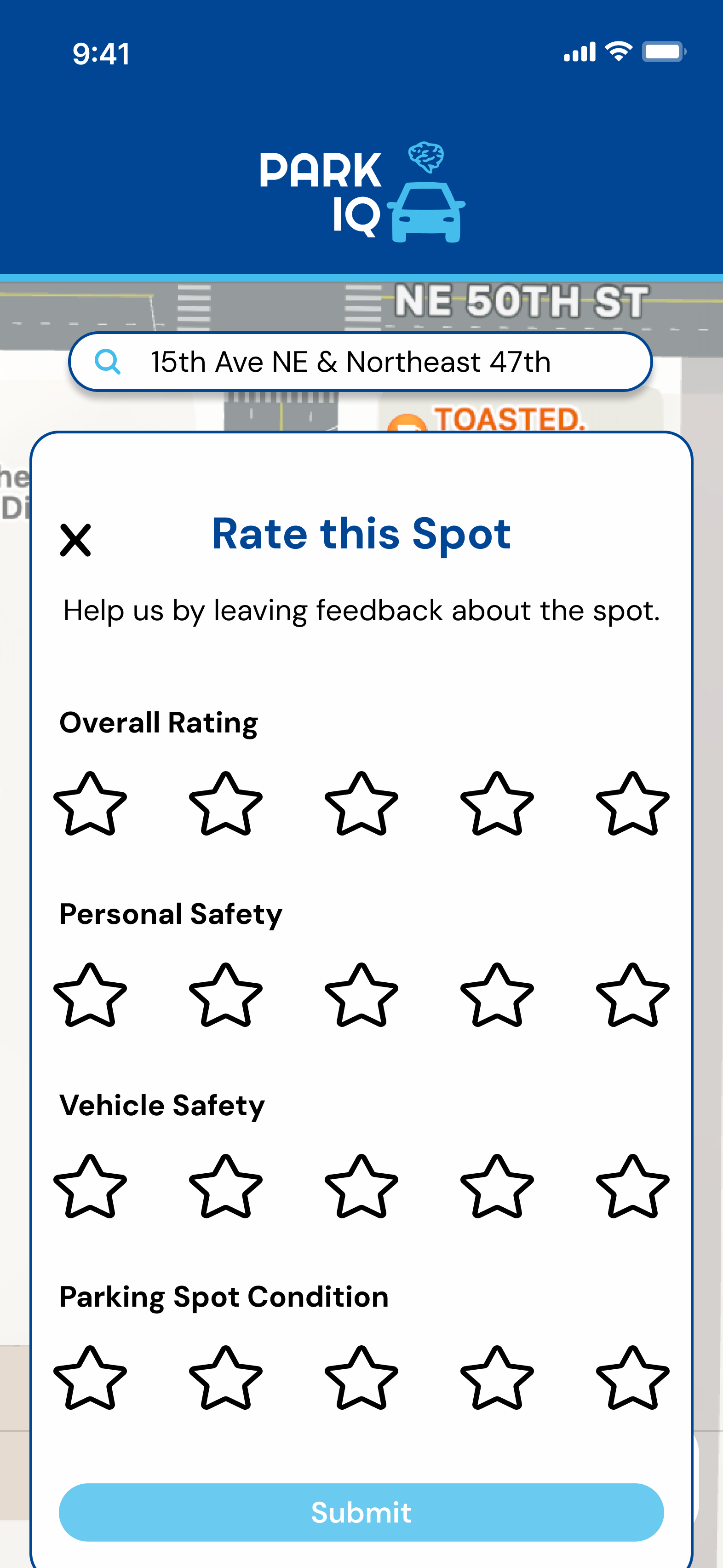
Once the user parks, they’re asked if they parked and to rate the spot after they’ve left, which provides information to other users about the quality and availability of the parking spot.
Users can share parking updates within their community to notify others of events or incidents that could impact parking. These updates can be verified by attaching links or pictures.
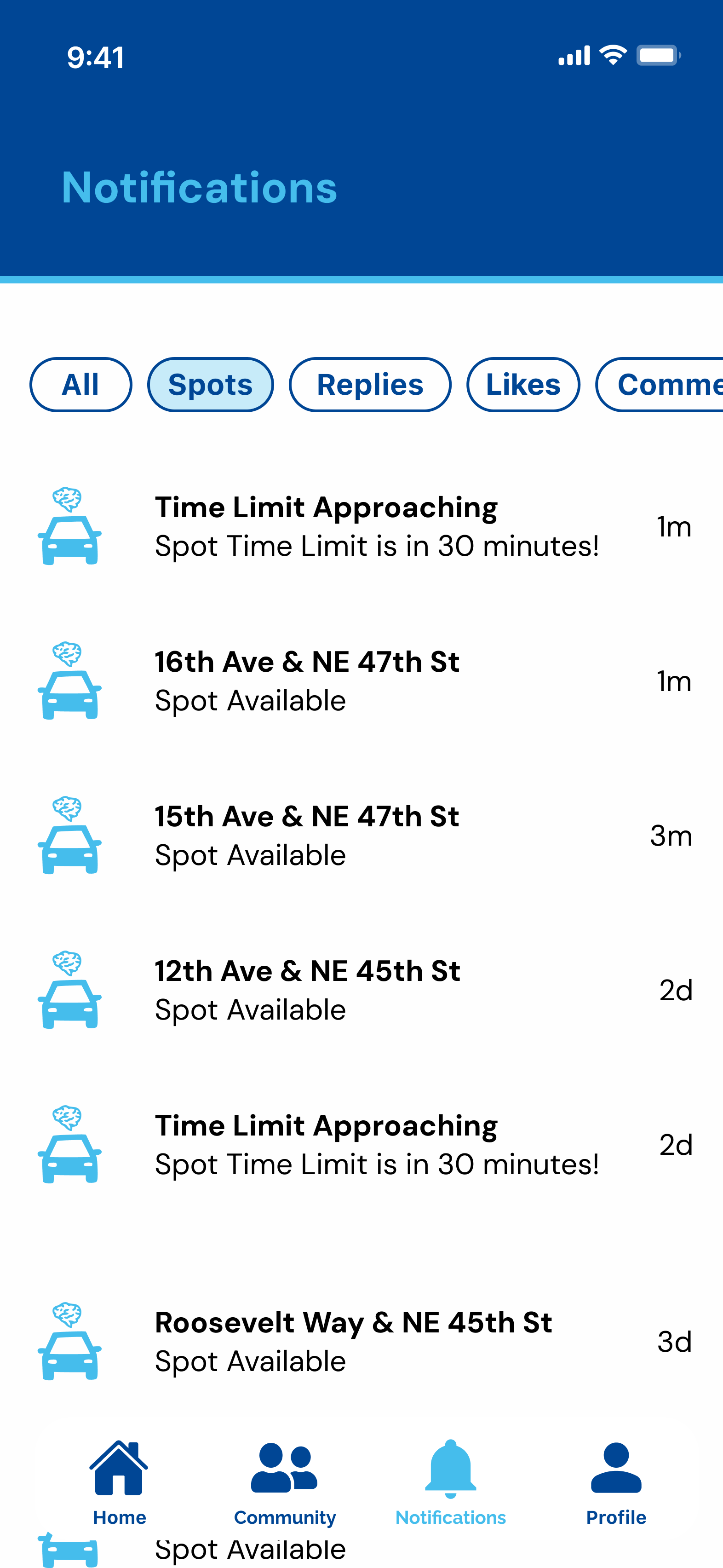
We created notifications to tell users about available parking spots in their area (if they want to be notified), as well as notification reminders if the parking spot they chose to park in has time limits, which were both features our interviewees wanted to see in our app.
Competitive Analysis
Existing parking apps
We noticed that almost all existing solutions focus solely on showing availability for parking garages, not street parking, which is the main type of available parking in University District.
spot hero logo

paybyphone logo

parkme logo

parkwhiz logo

Pros ✅
Trusted & verified, thorough info, parking garages
Pros ✅
Good for paying for parking, used by City of Seattle for paid parking
Pros ✅
Decent showing of availability
Pros ✅
Many events provide parking through this app
Cons ❌
Doesn’t show street parking
Cons ❌
Doesn’t show availability of parking spots
Cons ❌
Unreliable, parking data only for downtown
Cons ❌
Scams, unreliable
User Research
“I dread finding parking each time I’m in the area.”
All participants expressed frustration and stress while looking for parking around campus, which can be attributed to amount of time people spend trying to find parking, confusing signage, the limited number of parking spots available, or parallel parking.
Frequency vs Severity of Our Findings
Severity
Wasting time finding parking
Stress from finding parking
Lack of available parking
Parallel parking
Confusing signage
Parking far away from destination
Misjudging time limits
Parking in unsafe areas
Receiving tickets
Frequency
How might we...
Design a system that supports UW students using vehicles in U-District by streamlining the process of finding parking?
Ideation
Creating a parking reservation system
After considering various ideas, we decided to create an app interface using real-time parking data sourced from sensors on the road with a notification feature to reduce time spent looking for parking, and inform users where they are able to legally park, and of any parking restrictions, time limits, and safety concerns in the area.


Obstacles
Pivoting to a community-based app
During our mid-point feedback session, we received two key pieces of feedback: that a reservation system would be difficult to enforce and that our app may lead to distracted driving and safety concerns, prompting us to switch to a community-based app.
This change allowed us to provide crowd-sourced information about anything that could impact parking in U-District without the feasibility issues of a reservation system.
Before: Reservation System

After: Community-Based Informational App

Impact
User feedback
Although we did not collect metrics of the success of our app, several of our participants from usability testing expressed that they wished they could use our app to more easily find parking.
“I think about your app all the time and wish it existed so I could use it to find parking around Seattle.”
“ParkIQ would make it so much less stressful to find parking, and I wouldn’t have to worry about not knowing where to park.”
“If I could see the live updates people leave about parking in Seattle, I wouldn’t have to deal with going to an area to park, only to find out that I can’t park there.”
Reflection
What ParkIQ taught me
During the final week on this project, we briefly presented our final prototype and process, where we were told that by potentially spending more time on research for both the problem space and potential users, we would've
been able to avoid or reduce a lot of the back-and-forth we went through during the ideation and low fidelity phases.
I also got to learn a lot more about how to use components and auto-layout during this project, and I was really able to see the power of using these features to streamline the design process!